About Hangzhou
A landscape made
to hold feeling.
Hangzhou’s great work is not a palace or a single monument. It is the relationship between water, hills and everyday life.
01
The lake as an idea
Nature, carefully continued by human hands.
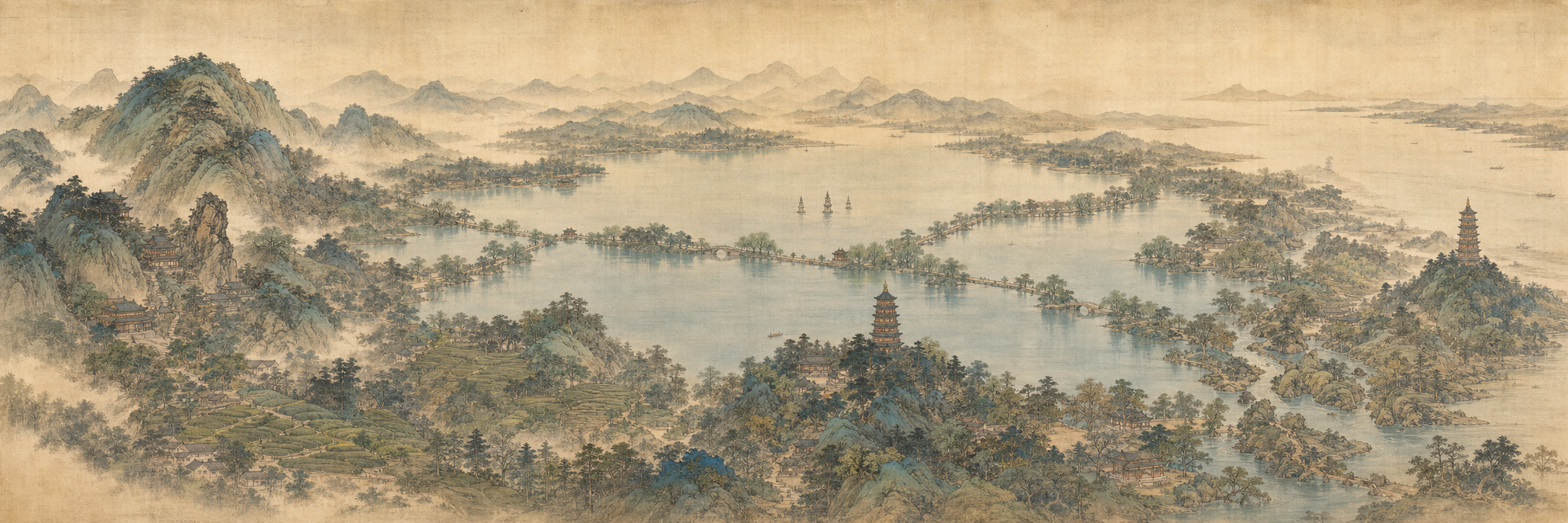
West Lake is surrounded by hills on three sides and the city on the fourth. Since the ninth century, poets, officials, monks, gardeners and residents have shaped its islands, causeways, temples, pagodas and planted shores.
The result is neither untouched nature nor formal garden. It is a sequence of changing views in which human interventions feel inseparable from water and mountain.
02
A living inheritance
The painting continues beyond its frame.
The same aesthetic system extends west into Buddhist valleys and tea villages, then south through Nine Creeks toward the Qiantang River. Ritual, agriculture, engineering and leisure remain part of its present life.
In 2011, the West Lake Cultural Landscape was inscribed on the UNESCO World Heritage List for its exceptional testimony to an idealised fusion of people and nature, and for its influence on landscape design across East Asia.
Read the UNESCO inscription ↗人在画中游